Travel Documents 143: The Free People’s Village
Genre: fiction, near-future, social change, cultural change
The Dust Cover Copy
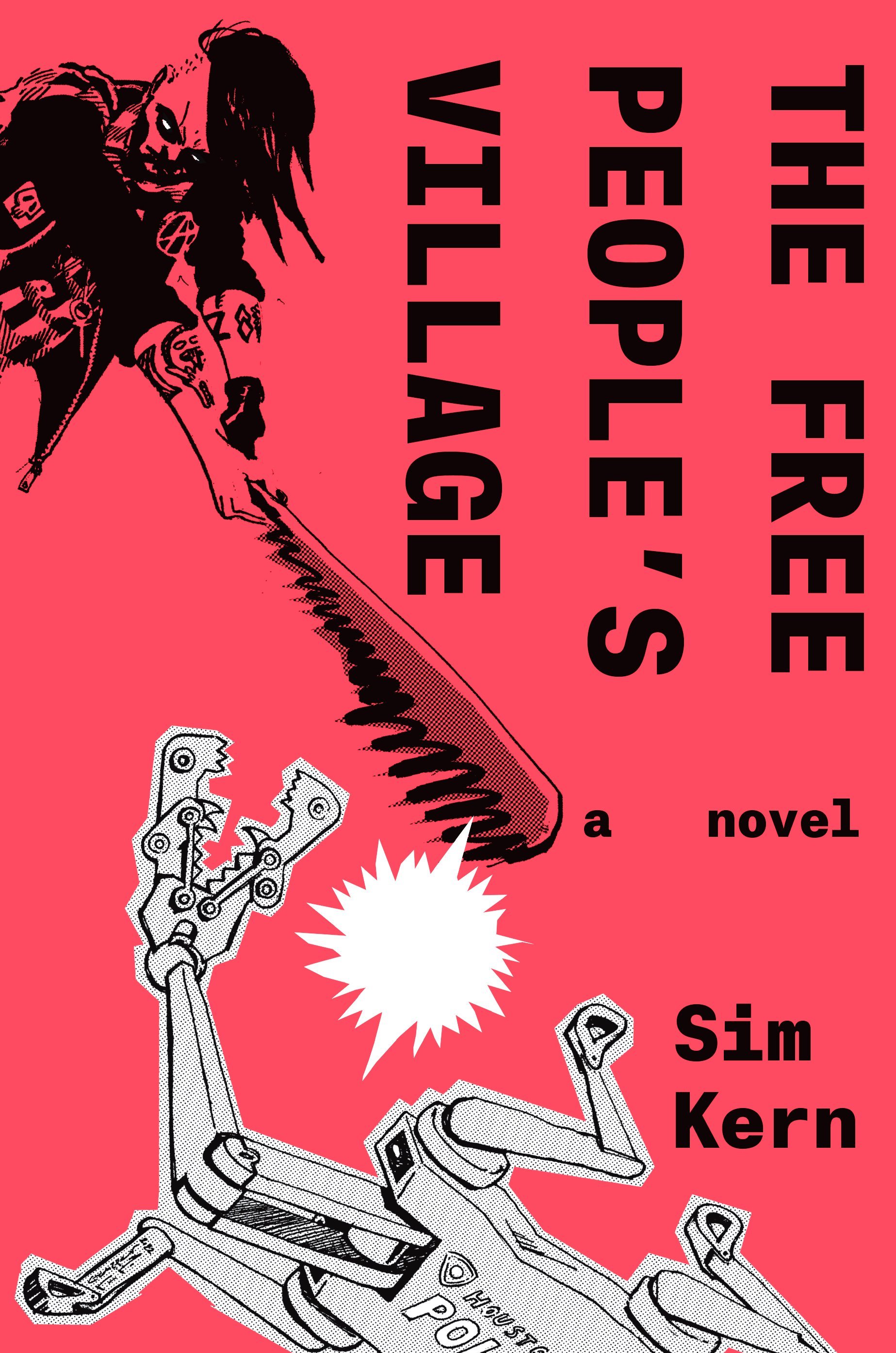
An alternate-timeline scifi novel exploring the failures of neoliberal climate policy, the Free People’s Village takes place in a 2020 where Al Gore won the 2000 election and declared a War on Climate Change rather than a War on Terror. For two decades, a supermajority of Democrats have passed sweeping climate regulation, transforming the country into a solarpunk utopia—but only for wealthy, white neighborhoods.
English teacher by day, Maddie Ryan spends her nights and weekends as the rhythm guitarist of Bunny Bloodlust, a queer punk band living in a warehouse-turned-venue called “The Lab” in Houston’s historically Black Eighth Ward. When Maddie learns that the Eighth Ward is to be sacrificed for a new electromagnetic hyperway out to the suburbs, she joins “Save the Eighth,” a Black-led organizing movement fighting for the neighborhood. At first, she’s only focused on keeping her band together and getting closer to Red, their reckless and enigmatic lead guitarist. But working with Save the Eighth forces Maddie to reckon with the harm she has already done to the neighborhood—both as a resident of the gentrifying Lab and as a white teacher in a predominantly Black school. As their protest evolves into a revolution, she must decide just how much she’s willing to sacrifice in pursuit of justice.
The Scene

Worldbuilding
This one gave me a lot to think about. I think I’m still thinking about it. But I think I’ve got some thoughts I can write down.
This book reimagines the present day as it would be if Al Gore had won his election and declared a War on Climate Change. Basically, everything is done for the enviroment in this version of the USA…in theory. But if you’re paying attention, you sure do see a lot of things done for money and for power. Beyond that, not a lot has changed. The type of people who like to be smug are now smug about how sustainable they are, how efficient their homes are, and how ecologically friendly their communities are. But for those on the bottom of society, not a lot is different. They’re just guilted for slightly different things. They’re still disenfranchised. They’re still criminalized for psuedo-crimes based less on actions than on demographics, but now those crimes are carbon credit fraud rather than drug use. They’re still treated as people you can move on whenever their presence is inconvenient. And the middle class is still absolutely clueless about it most of the time. But in this book, they hear about it loud and clear when a new electomagnetic hyperway to take the well-heeled from their jobs to their suburbs is proposed. It will unhouse hundreds. It will ruin lives. And the community of the Eighth Ward isn’t going to let it happen without a fight.
The Crowd

Characterization
It’s the characters who really make this story. And the characters here, reacting to their circumstances, make something that is the first cousin to a Greek tragedy.
There’s Maddie, a lost girl who’s tried all the wrong ways to be a good person and do good things. There’s Red, who transmutes all xir pain into music and all xir struggles into a tough punk veneer. Gestas, a man whose circumstances have taught him how rotten the system’s foundations really are. And Fish, a man whose good intentions are endlessly undermined by his inability to look outside himself and his ego. Around them is their community, the Eighth Ward, and their society. That’s a bit of a mess. There’s Respectable People and there are activists. There’s a media hungry for another story. There’s the scene crowd looking for a new party. And in there are a few true idealists who are trying to create a better world. The characterization style is like a bracing cup of coffee: it’s bitter, and you have to take it slow at first. But it starts your heart beating and it makes you want to get up and act.
Maddie serves as the access character, and through her we see the greatest growth. We also learn some painful but important lessons. This is the most important: in life, there aren’t a lot of decisive victories. Happy endings don’t happen for everybody, and they don’t happen often. If you’re doing something for the win, for the happy ending or for the victory parade, you’re going to get your heart broken. You have to do it because it’s the right thing to do. You have to do the right thing even when it’s hard. Even when you fail. You have to keep doing it. And you have to take small joys where you can. You can’t be a wildfire. Wildfires don’t last. You have to be a small coal: always alight, always ready to flare in the dark when you must. Never put out.
Writing Style

In style, this work leans strongly into the personal story form. This makes it feel both more present and at points almost excruciatingly awkward. You really feel like you’re with the characters as they grapple with all the hard questions: am I a good person if I’m also a gentrifier? If I’m doing work for a bad system, can I be a good person? Where can I feel safe? What am I really worth in the world. Is something wrong with me, or is the world that something is wrong with? And how the hell am I going to sober up our bandmate before the next set?!
I did feel at points that some of the characters were a little on the nose: a former evangelical turned punk and a white teacher educating a disengaged black class on ‘To Kill A Mockingbird’ were such obvious chances to comment on how messed up our society is struck me as almost too obvious. But complexity was layered onto the situations by the personalities of the characters, and it worked in the end.
Given the material being discussed, Kern’s very personal, almost journal-writing approach to the framing made for a truly intersectional and truly complex story. There are no easy good guys and bad guys in this story. Everyone has done some harm, and everyone has tried to do some good. What really defines people is what they decide to do when they are told what their actions have done. Do they self-protect and hide to protect their egos? Or do they straighten up, step up and do the work to become better in the future? Life is messy, Kern’s style reminds us over and over. Life doesn’t have easy answers. But what we can do is be honest, be open to change, and try to be the best we can be. What we can do is choose other people’s lives and other people’s dignity over our own egos.
The Moves

Plot
This is not an easy story. It’s not a comfortable story. It’s the closest that most of us will ever get to living in a real revolutionary commune: a place where people argue over the chores roster, where people are balancing the social project with their grandma’s meal times, a place where real people work and try to do good and fight and mess up. It’s a place where one person’s bid for ego enhancement or ‘bright idea’ can harm an entire community. It’s a place with hard choices made by lots of scared people. And it isn’t easy. And it isn’t glorious. And maybe it isn’t even going to last. But while you’re there, you know that you’re there for each other. And you know you’re trying to do something good.
Another important theme in this work is the way in which power structures perserve themselves, and how easy it is for them to remain even as they say they’re changing. One of the most salient elements is the way in which socially palatable concepts are used to white (or in this case green) wash actions that those in power want to take. In George Bush’s world, we attacked Iraq in a ‘war on Terror’, as in we wanted to control their oil and get them to stop making us feel anxious about our resources. In Al Gore’s world, we attack a South Amercian country in a millitary bid to make them stop burning the rainforest (cough yeah right) and in the process we export a lot of their oil. So we really fought them to get control of their oil and get them to stop making us feel anxious about our resources. Same song, different verse. The world Kern writes is used to force us to really grapple with the fact that we don’t need to change the paint job on our society: we need to change the foundations. Otherwise the same things will happen under different names. In George Bush’s world, economically neglected neighborhoods are bulldozed to remove urban blight. In Al Gore’s, they’re bulldozed to remove ecological harm. But those homes sure got bulldozed either way. Real change would be a world where the neighborhood got support, not a lot of platitudes and an eviction notice. Real change means actually respecting people, not finding a socially acceptable way to discount, dismiss and disenfranchise them. Anything short of that is just painting over the cracks. Kern writes a story that makes us really understand that.
Fair warning and (hopefully) no spoilers, don’t look for happy endings from this work. It’s as real as you’re going to get, and that includes the messy kinds of endings to so many social movements. It explores the fact that many of the big social movements will dissolve or be dissolved by the Powers that Be. But this story also says there will be another time to act. And another. And another. The point isn’t for any one action to be The Revolution. The point is to keep acting. You might not win. But you may change things. And that will be where the next action can start. This book showcases this reality and underlines the quiet power inherent in it. Where some see despair in yet one more failed action, others point at the same act and say ‘this, right here, will spread ripples into the future. That’s why it’s worth doing.’
The ones who give into despair don’t last. The ones who see the ripples do.
Overall Rating

A painful, honest and messy exploration of what it means to stand up when you must. A solid read.